Events
Past Events
Webinar on New Labour Codes: Employer Readiness
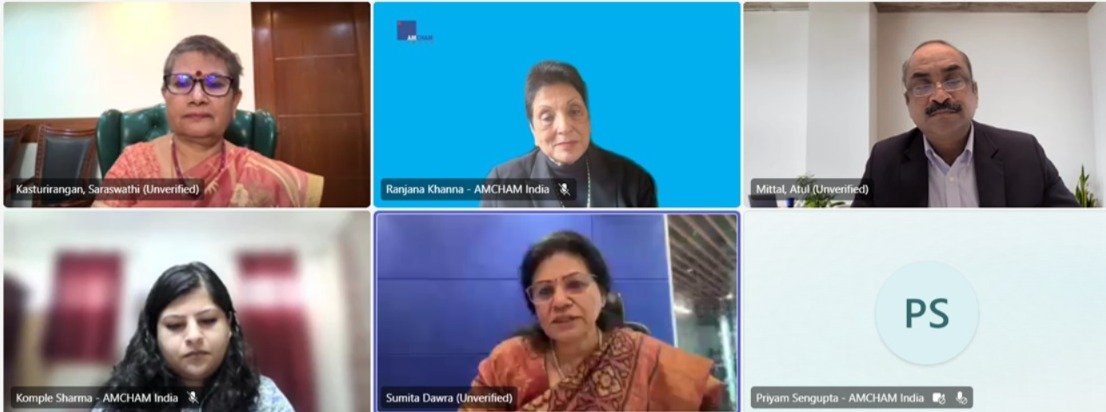
AMCHAM India organized a webinar on ‘New Labour Codes: Employer Readiness’ on November 28th, to deep dive into salient features of the labour code and how organizations can prepare for this major transition. Ms. Ranjana Khanna, Director General CEO, AMCHAM welcomed speakers and participants. She spoke about how the four codes bring major reforms but also present practical challenges for large and multinational companies. Ms. Sumita Dawra, Former Labour Secretary, Government of India, Ms. Saraswathi Kasturirangan, Partner and Chief Happiness Officer, Deloitte and Mr. Atul Mittal, Partner, Deloitte India were the expert speakers.
Ms. Sumita Dawra gave an overview on the newly notified labour codes, announced on November 21 st , 2025, which are intended to both enhance worker welfare and improve ease of doing business. Some of the salient points included:
- Consolidating 29 existing labour laws into 4 simplified codes, reducing 1,232 sections to 480.
- Updated outdated legislation to reflect current economic realities, technological change, and global trade dynamics.
- Strengthened worker welfare through better social security, minimum wages, and timely wage payments.
Support ease of doing business by:
- Creating uniform definitions, such as a unified definition of wages.
- Reducing compliance burdens, minimizing red tape, and eliminating “Inspector Raj.”
- Transitioning labour inspectors into inspector-cum-facilitators focused on guidance and improvement rather than punishments.
- Introducing web-based, randomized inspections, electronic returns, single registrations, online licensing, auto-renewals, and deemed approvals.
- Decriminalizing minor violations and replacing most penalties with fines and improvement notices.
- Relaxing thresholds related to factories, contract labour, and layoffs, reducing regulatory pressure on SMEs and start-ups.
- Establishing streamlined advisory boards such as the Occupational Safety, Health and Working Conditions Advisory Board.
- Inclusion of fixed-term employment, allowing employers flexibility to hire directly for specific projects while ensuring better social security for workers compared to traditional contract labour.
- Other measures include sunset clause for dispute resolution, faster adjudication through strengthened tribunals, and mandatory 14-day strike notice which aims to reduce disruptions and support industrial stability.
She emphasized that the labour codes will bring simplification, transparency, and modern governance, that will boost productivity and consumption by improving worker welfare and enabling businesses to operate more efficiently.
Ms. Saraswathi Kasturirangan and Mr. Atul Mittal explained the transition from the old laws to the new code and how it is bringing uniform definitions, greater use of technology, increased accountability, and simplified compliance through reduced filings and digitization.
Major organizational impact areas include:
1. New Uniform Definition of Wages
- Applies across all codes.
- Exclusions capped at 50% of total remuneration.
- Likely financial impact on gratuity, leave encashment, PF eligibility, bonus applicability, etc.
- May significantly increase cost calculations as “wages” could become higher than current basic pay structures.
2. Gratuity Impact
- For regular employees, gratuity will now be computed on the new wage definition, causing retrospective cost increases for past service.
3. Fixed-Term Employees
- Must receive benefits similar to regular employees.
- Eligible for gratuity after 1 year (pro-rata).
- Organizations must evaluate workforce costs and structures.
4. Minimum Wages and National Floor Wage
- Central government will set a national floor wage.
- State minimum wages cannot fall below this.
- Organizations must await the notification before implementing.
5. Women Workers
- Can work night shifts with consent and necessary safety measures.
6. Workforce Categorization and Compliance Mapping
- Organizations need to map compliance requirements across categories:
- Fixed-term employees
- Contract labour
- Inter-state migrant workers
- Women workers
- International workers
7. Digitization and Simplification
- Reduced registrations and licenses.
- Dispute resolution timelines shortened (e.g., 2 years under PF).
- Overall aim is simplified, tech-enabled compliance.
8. Industrial Relations (IR) Code and the Occupational Safety, Health and Working Conditions (OSH) Code
- Contract labour is not allowed in core activities, except where the nature of work normally requires it / full-time workers are not needed / or there is a temporary surge in workload.
- Multiple registrations are simplified into one unified registration under the new codes.
- All employees must receive new appointment letters within three months, including required details like Aadhaar, LIN, UAN, ESIC and EPFO numbers.
- Leave eligibility is relaxed: working 180 days in a year (instead of 240) now qualifies an employee for annual leave.
A 30-day cap on carry-forward leave is introduced; excess leave must be encashed, and organizations cannot accumulate large leave balances. - Overtime rules remain (8 hours daily, 48 weekly), but employers must obtain written consent from workers for overtime, preferably built into appointment letters.
- A mandatory grievance redressal committee (up to 10 members) with equal employer–employee representation, including women, that must resolve complaints within 30 days.
- A new reskilling fund requires payment of 15 days’ wages to retrenched workers, with the government disbursing this amount within 45 days; retrenched workers must be given rehiring preference for one year.A single negotiating union concept is introduced to streamline collective bargaining.
- Gratuity continues after five years but is now also available to fixed-term employees who complete at least one year.
- Women are permitted to work between 7:00 p.m. and 6:00 a.m. with written consent, transportation facilities, and mandatory crèche support for establishments with 50+ employees.
- Compliance with the Sexual Harassment of Women at Workplace Act, 2013 remains mandatory alongside the new provisions.
9. Challenges and Ambiguities
- Dependence on state rules under the concurrent legislative framework.
- Overlap between labour codes and existing Shops & Establishments Acts, which will continue to apply.
- Pending clarity on:
- Whether variable pay, one-time payouts, and benefits in kind (stock options, car leases) count as wages.
- Some provisions (ESI, maternity/crèche facilities, minimum wages) that rely on rules yet to be issued.
The key takeaways from the session included:
- Organizations must review their current wage structures and assess how they align with the new definition of wages, including the impact on coverage and financial costs such as gratuity.
- All employment-related documents, contracts, and internal policies should be evaluated and updated to ensure compliance with the labour codes.
- Companies need to analyse their workforce composition — workers, contract labour, interstate migrant workers, women employees — and check whether thresholds triggering additional compliance obligations are being crossed.
- Activities outsourced to contractors should be reviewed to confirm whether any involve core activities, which generally cannot be performed by contract labour except under specific exemptions; organizations may need to consider shifting some roles to fixed-term employment instead.
- HR policies should be updated, including creating or revising policies on maternity benefits, crèche facilities, and other benefits, as required once rules are fully notified.
- Payroll and wage payment processes must be re-examined because payment of wages timelines now apply to all employees, not just those below a certain salary threshold, making timely payment critical.
- Organizations must review compliance with overtime rules, wage timelines, and consolidated forms under the digitized system.
- Fixed-term employment provisions should be reassessed and incorporated into workforce planning and policy updates.